| Author | Published |
|---|---|
| Jon Marien | February 17, 2026 |
What it is
Blind SSRF is when you can cause an application to make a back-end HTTP request to a URL you supply, but the response is never returned to you. You’re firing requests into the dark — you know something happened, but you can’t see the result.
Core Idea
Unlike regular SSRF where the server’s response leaks back to you, blind SSRF is a one-way street. The server makes the request, but you get nothing back. This makes it trickier to confirm and exploit, but it’s still dangerous.
Why it’s Bad / Impact
Because you can’t read responses, you can’t directly pull sensitive data like you could with standard SSRF. That said, it’s far from harmless:
- Internal network probing — you can sweep internal IP ranges and port-scan back-end services blindly
- Vulnerability detection — you can send known exploit payloads to internal servers and see if they trigger callbacks, potentially uncovering unpatched systems
- Malicious response attacks — if you can get the server to connect to you, you can serve crafted malicious responses back to its HTTP client, potentially triggering client-side vulnerabilities and achieving RCE
- Full RCE is possible, though it requires chaining vulnerabilities and is harder to pull off than standard SSRF
How to Find It — OAST Techniques
The go-to method for detecting blind SSRF is Out-of-Band Application Security Testing (OAST). Since you can’t see the response, you instead watch for the server “calling home” to a domain you control.
The workflow looks like this:
- Generate a unique external domain using Burp Collaborator (or an alternative like
interactsh) - Inject that domain into a request parameter the app might use for back-end HTTP calls
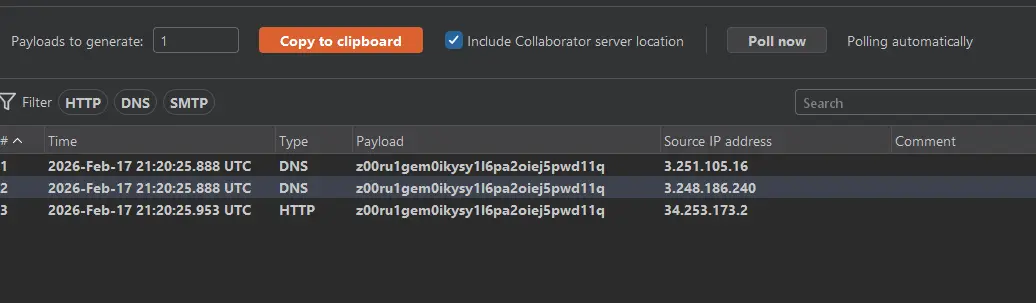
- Monitor Collaborator for any DNS lookups or HTTP requests coming from the app’s server
- If you see a hit — the app is vulnerable to blind SSRF
Important nuance: You might see a DNS lookup but no HTTP request follow up. This means the app tried to reach your domain (triggering a DNS resolution), but a network-level firewall blocked the actual HTTP connection. DNS is commonly allowed outbound even when HTTP isn’t, so this partial hit still confirms something useful — there’s likely a blind SSRF present, just with outbound HTTP filtering in place.
How to Exploit It
Just finding the blind SSRF isn’t enough on its own — you need to chain it into something useful. Here are the main exploitation paths:
- Internal IP sweeping — blindly send requests to internal IP ranges (e.g.,
192.168.0.0/24) with payloads targeting known CVEs on common services; use OAST callbacks to confirm hits - Unpatched internal server discovery — internal servers are often less patched than public-facing ones; a blind sweep can uncover critical vulnerabilities on systems that were never meant to be exposed
- Malicious server response (RCE path) — force the application to connect to a server you control, then return a malicious HTTP response crafted to exploit vulnerabilities in the server’s HTTP client library, potentially achieving remote code execution inside the application’s infrastructure
Protect Against It
- Apply the same SSRF defenses as standard SSRF — allowlists, blocking internal IP ranges, disabling unnecessary redirects
- Validate and restrict outbound traffic at the network level — limit what the app server can reach externally
- Keep internal systems patched, since blind SSRF is often used to exploit vulnerable internal services
- Monitor for unusual outbound DNS/HTTP traffic from your application servers — anomalous external lookups can be an early indicator
- Avoid using user-supplied input to construct back-end HTTP requests wherever possible
Lab
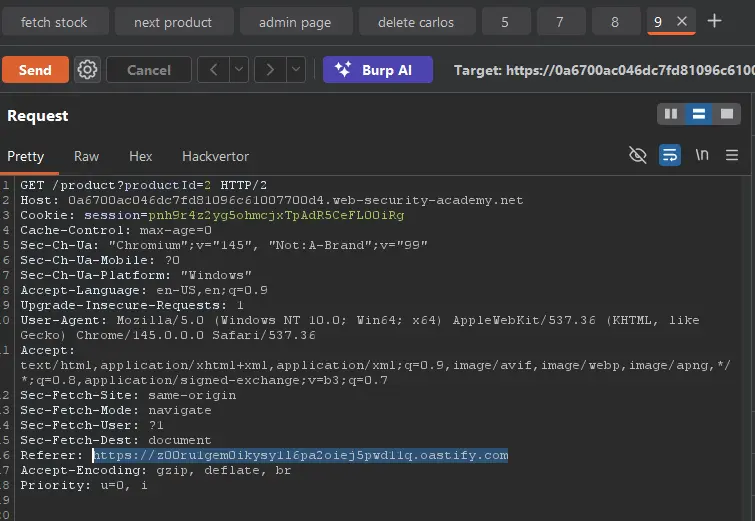
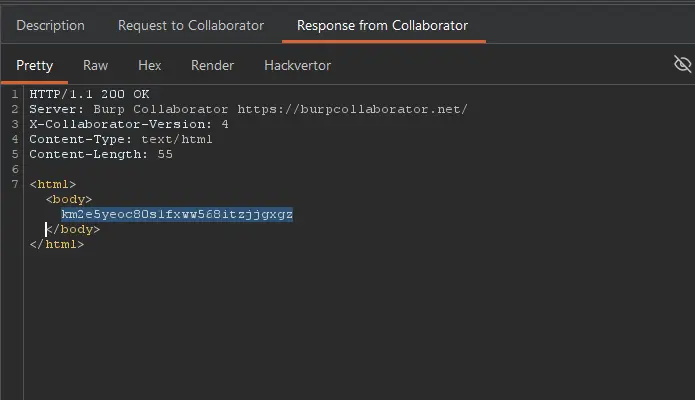
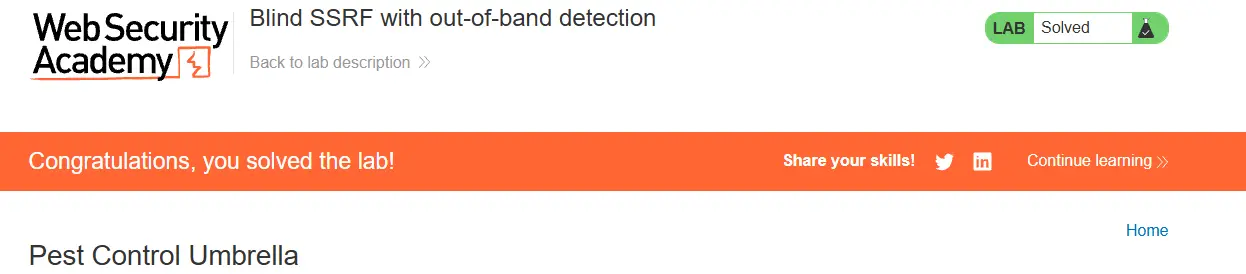
Replace Referer with collaborator URL! Then check Collaborator.
All done!