Writing Data
Writing Memory
%n will deference a pointer from the stack and write the number of bytes written so far to it.
int namelength;
printf("%s%n", name, &namelength);
printf("The name was %d bytes long!", namelength);
Why is this bad?
%n requires a pointer to where we want to write. But:
- If our buffer is on the stack (and we can put a valid pointer into it), we can use that!
%7$n(and other offsets) let us use different pointers on the stack.- Frame pointers point to each other!

- We can target
ebp1for%nand modifyebp2, then targetebp2.
This lets us operate independently of the stack ASLR!
Writing Memory Using Your Own Format String Attack
If our format string is on the stack:



This means that we can reference values in our format string using %[]$n.
How do we figure out the []?
Writing Memory - Cont.
Problem: %n writes 4 bytes.
Solution:
%ln%hn%hhn
Problem: How do we control what to write?
Solution:
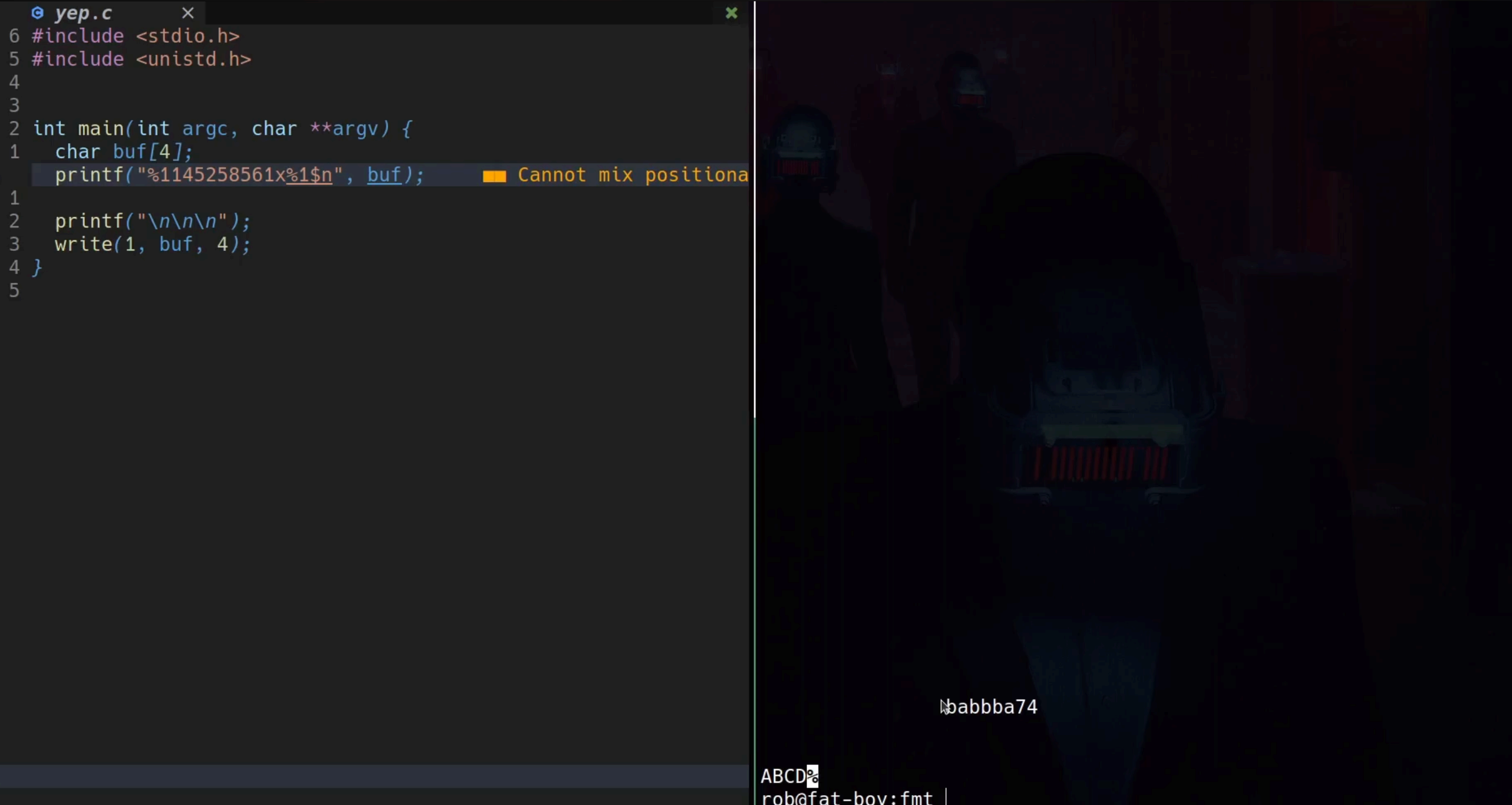
char buf[4];
printf("1145258561x%1$n", buf);
This writes “ABCD”, (with a shit ton of whitespace to the prefix) to buf!
Demo:
Problem: How do we limit the output amount?
Solution:
char buf[4];
printf("%65x%1hhn%c%2$hhn%c%3$hhn%c%4$hhn", buf, buf+1, buf+2, buf+3);
This writes “ABCD” to buf, but with lower cost!
How can we write “DCBA”?
Copying Memory
One more thing: %*10c%11$n
* specifies a dynamic padding size. This will:
- Get the 10th parameter.
- Use it as the padding size of a single character.
- Print that many bytes.
- Write the number of bytes printed to memory pointed to by the 11th parameter. This results in a copy.
Problem: Not realistic for large values, too much output.